11.27.2011
this thing that didn't really happen to me.
one time i woke up in an alternate reality where all the major religions lost to animism. ordinarily that wouldn't have been so bad, except for that i was fined for having too many picture frames in too small a space. at least i wasn't arrested like the guy next door, though. he got charged with toaster cruelty. twenty-five to life.


dud genies installment three.
I GRANT YOU THREE KNISHES.*
*not considered a dud genie by people who enjoy knishes.
*not considered a dud genie by people who enjoy knishes.
11.23.2011
indigenous peoples installment two: the ainu
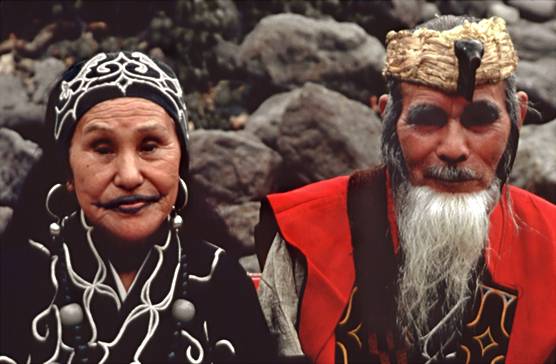
who: indigenes thought to be descendants of the jōmon-jin people.
where: japan and russia.
language(s): variations of ainu which, today, are spoken by fewer than one hundred people. the ainu languages have no written system, and they differ slightly from japanese in terms of syntax, vocabulary, morphology, etc.
culture: traditionally, the ainu did not shave after a certain age. both men and women had the same length of hair to the shoulders, and women tattooed their mouths and forearms. men primarily ate with chopsticks while women used wooden spoons.
dwellings: reed-thatched huts with central fireplaces and no partitions.
clothing: robes of varying lengths and other garments spun from the bark of elm trees. earrings were worn by both men and women, and in winter the people favored animal skins for warmth. for important ceremonies, men wore a wooden crown called a sapanpe, while women wore an embroidered headband called a matanpushi.
law: traditionally, capital punishment and jailing were not used to reprimand criminals. instead, violators of the law were beaten, or in the case of murder, were subject to having their noses and ears cut off and/or tendons in the feet severed.
diet: the ainu fished, hunted and gathered seasonal game and plants, which were then typically either cooked, smoked or dried for preservation and placed in storehouses. common proteins included bear, fox, salmon and deer.
religion: many are now practitioners of christianity, russian orthodoxism and buddhism, but animism is the traditional religion of the ainu people. animistic ceremonies frequently involved "sending back" the spirits of killed animals.
language(s): variations of ainu which, today, are spoken by fewer than one hundred people. the ainu languages have no written system, and they differ slightly from japanese in terms of syntax, vocabulary, morphology, etc.
culture: traditionally, the ainu did not shave after a certain age. both men and women had the same length of hair to the shoulders, and women tattooed their mouths and forearms. men primarily ate with chopsticks while women used wooden spoons.
dwellings: reed-thatched huts with central fireplaces and no partitions.
clothing: robes of varying lengths and other garments spun from the bark of elm trees. earrings were worn by both men and women, and in winter the people favored animal skins for warmth. for important ceremonies, men wore a wooden crown called a sapanpe, while women wore an embroidered headband called a matanpushi.
law: traditionally, capital punishment and jailing were not used to reprimand criminals. instead, violators of the law were beaten, or in the case of murder, were subject to having their noses and ears cut off and/or tendons in the feet severed.
diet: the ainu fished, hunted and gathered seasonal game and plants, which were then typically either cooked, smoked or dried for preservation and placed in storehouses. common proteins included bear, fox, salmon and deer.
religion: many are now practitioners of christianity, russian orthodoxism and buddhism, but animism is the traditional religion of the ainu people. animistic ceremonies frequently involved "sending back" the spirits of killed animals.
"this type which at present is to be found everywhere, and everywhere imposes his own spiritual barbarism, is, in fact, the spoiled child of human history. the spoiled child is the heir who behaves exclusively as a mere heir. in this case the inheritance is civilisation- with its conveniences, its security; in a word, with all its advantages. as we have seen, it is only in circumstances of easy existence such as our civilisation has produced, that a type can arise, marked by such a collection of features, inspired by such a character. it is one of a number of deformities produced by luxury in human material. there might be a deceptive tendency to believe that a life born into a world of plenty should be better, more really a life than one which consists in a struggle against scarcity.
such is not the case, for reasons of the strictest and most fundamental nature, which this is not the place to enlarge upon. for the present, instead of those reasons, it is sufficient to recall the ever-recurrent fact which constitutes the tragedy of every hereditary aristocracy. the aristocrat inherits, that is to say, he finds attributed to his person, conditions of life which he has not created, and which, therefore, are not produced in organic union with his personal, individual existence. at birth he finds himself installed, suddenly and without knowing how, in the midst of his riches and his prerogatives. in his own self, he has nothing to do with them, because they do not come from him. they are the giant armour of some other person, some other human being, his ancestor. and he has to live as an heir, that is to say, he has to wear the trappings of another existence.
what does this bring us to? what life is the "aristocrat" by inheritance going to lead, his own or that of his first noble ancestor? neither one nor the other. he is condemned to represent the other man, consequently to be neither that other nor himself. inevitably his life loses all authenticity, and is transformed into pure representation or fiction of another life. the abundance of resources that he is obliged to make use of gives him no chance to live out his own personal destiny, his life is atrophied." -jose ortega y gasset (1930)
such is not the case, for reasons of the strictest and most fundamental nature, which this is not the place to enlarge upon. for the present, instead of those reasons, it is sufficient to recall the ever-recurrent fact which constitutes the tragedy of every hereditary aristocracy. the aristocrat inherits, that is to say, he finds attributed to his person, conditions of life which he has not created, and which, therefore, are not produced in organic union with his personal, individual existence. at birth he finds himself installed, suddenly and without knowing how, in the midst of his riches and his prerogatives. in his own self, he has nothing to do with them, because they do not come from him. they are the giant armour of some other person, some other human being, his ancestor. and he has to live as an heir, that is to say, he has to wear the trappings of another existence.
what does this bring us to? what life is the "aristocrat" by inheritance going to lead, his own or that of his first noble ancestor? neither one nor the other. he is condemned to represent the other man, consequently to be neither that other nor himself. inevitably his life loses all authenticity, and is transformed into pure representation or fiction of another life. the abundance of resources that he is obliged to make use of gives him no chance to live out his own personal destiny, his life is atrophied." -jose ortega y gasset (1930)
Subscribe to:
Posts (Atom)